Uncategorised

Guide-stones around Skipton: the ‘Craven stoops’

Around the Skipton area are over 20 small triangular stones, mostly painted white with black lettering, most with a pyramidal top, and found mostly at minor road junctions. Village names, sometimes with arrows or crude hands painted on them, direct the traveller along the lanes.

They can be found throughout the Craven District – in Bolton Abbey, Coniston Cold, Cracoe, Draughton, Eshton, Gargrave, Linton, Stirton-with-Thorlby, Thorpe and Threshfield.

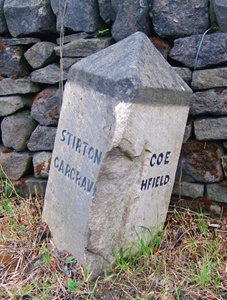
A typical example, YN_XXSGCT, illustrated here, is on the B6265, about a mile north of the Skipton northern by-pass. It is at the junction of Bog Lane (an indication, perhaps, of its formerly uninviting condition) with the B6265, just before the oddly-named None-Go-Bye Farm. The narrow Bog Lane leads directly to Stirton, and thence to Gargrave – as indicated on the left-hand side of the stone. The right-hand side shows directions to Cracoe and Threshfield (though these destinations are incomplete, perhaps following an altercation with a road vehicle).

There is, however, no indication that the main road leads back to Skipton, suggesting that whoever erected it assumes this is the direction you have come from – though if this was the case and you really wanted to go to Stirton or Gargrave you wouldn’t have come this way.

The stones are stylistically quite different from those erected in response to the demands of the County Justices at the turn of the 18th century: those were aimed at travellers on featureless moorlands. And since there are so many of them in a very similar style they are unlikely to be the work of different parishes.

They were in fact erected in the second half of the 19th century: this stone (like many of the others) appears on the 1896 Ordnance Survey map, but not on the 1853 edition.  And they were put up by the East Staincliffe Highway District (ESHD). This was one of many Highway Districts created in the 1860s, taking over the functions of parishes (who thus gave up their highways responsibilities) and, later, the failing Turnpike Trusts. They were abolished following the creation of Rural District Councils in 1894.  The East Staincliffe Highway District, named from the ancient wapentake of the same name, also erected a number of boundary stones in the area; these are marked E S H D.

RWH / Feb 2019

Guide-stones around Skipton: the ‘Craven stoops’ Read More »

Mounting-block milestones

The most common type of milestone is what we call the “tombstone” type, a thick stone pillar well embedded in the ground with mileages carved or painted, or with a cast-iron plate screwed onto it.

Occasionally, however, a different type is found, the horse mounting-block, or horsing-stone.  They combine the directions and mileages of the traditional milestone in a (usually) three-stepped stone to enable travellers to get on or off a horse easily. 

Quite why anyone should need to do this at a milestone is not clear.  It does, however, indicate that many travellers were on horse-back.

Mounting-block milestones survive in all three Yorkshire Ridings.

The only road entirely in the North Riding to have them was the York-Oswaldkirk turnpike.  In 1772 the trustees ordered that milestones be erected “in the form as follows: wood mile post 4½ feet in length; every third mile a horsing stone”.  Four of these are still in position.  Others can be seen on roads leading into the east Riding.

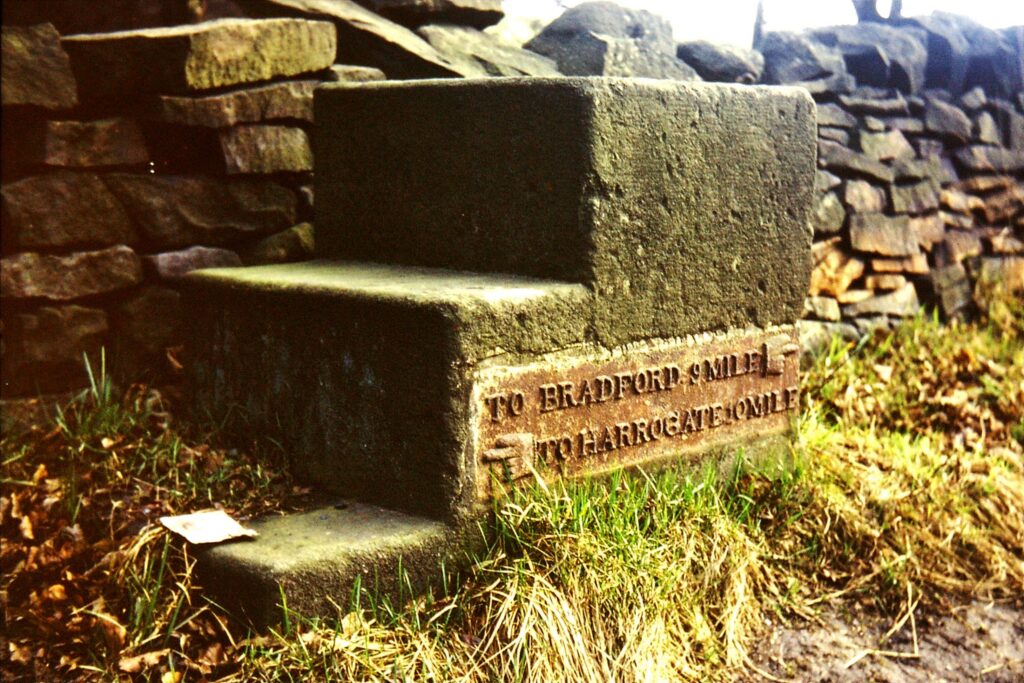
In the West Riding there are half-a-dozen on the road between Bradford and Harrogate.  These have (or in most cases had) a cast-iron plate giving destinations and distances.  One, at Pool, retains its plate – illustrated here.

Another six survive on the original turnpike between Leeds and Otley, dating from the middle of the 18th century.  This road is now an unclassified road leading more directly and steeply from Otley and was replaced by the present A660 in 1842.  With destinations carved on the front and side, most are now badly weathered.

It is in the East Riding, however, that most can be found: in fact over 50 of the 108 milestones recorded by the Milestone Society are of the mounting-block type  – a feature unique in its frequency in the country.

The roads with mounting-block milestones include Beverley-Hornsea, Hull-Beverley, Hull-Hedon, Hull-South Cave, York-Beverley and York-Driffield.  Many have deteriorated from weathering, or suffered damage from grass-cutting, or traffic accidents, and many have lost their plates, but the County Council and Milestone Society members have been actively renovating them as time and resources permit. 

Click here for more information on the East Riding milestones.

Outside Yorkshire there is an interesting series of “horsing-stones” on the old Great North Road in Lincolnshire. The 4th edition of Paterson’s Roads of 1788 notes: ‘From Stilton to Grantham, at every Mile are Blocks, made of the famous Ketton Stone, with three Steps, which were placed there by a Mr. Boulter, for the easy mounting of his Horse, he being a very corpulent Man, and travelled that road every Week for many Years; each Stone engraved E.B. 1708.’ Milestone Society members have been researching these “Boulter stones” and their latest findings can be found on the Milestone Society website.

RWH / revised Jan 2022

Mounting-block milestones Read More »

Milestones on the York to Oswaldkirk Turnpike

Oswaldkirk is a village 20 miles north of York and four miles south of Helmsley in North Yorkshire. It is named after St Oswald (died 642), Anglo-Saxon king of Northumbria.

The turnpike was established by Act of Parliament in 1768 and followed the line of the present B1363. At Oswaldkirk the turnpike joined the present B1257, which with the A170 connected it with Helmsley. It thus provided a more direct connection to that area.

The milestones on this road are interesting, as every third stone is a so-called ‘horsing-stone’ – a tall block with steps to enable easy mounting of a horse. The minutes of the Turnpike Trust include the following details.

In 1772 ‘. . . milestones were to be erected … in the form as follows: wood mile post 4 feet in length; every third mile a horsing stone; … ‘. Later, in 1776 it was ordered ‘… that the mile posts be painted dark blue, with white letters and figures, old Roman capital letters and figures ‘. At a meeting at the (still there) White Bear in Stillington in 1789, it was ordered ‘. . . that the mile stones be repaired if necessary and that the letters or figures thereon be fresh painted’.

In 1814 it was ordered ‘that mileposts be erected at the end of each mile where the present stones are decayed and defaced, and that the first mile from York be measured from Bootham Bar, or such other place as the distance has commenced, and be so expressed upon the first mile post‘.

The Milestone Society has records of four surviving horsing-stones (or mounting-blocks) on this road. They are, from south to north:

At Wigginton, ¾ mile north of the A1237 York ring-road, on the west side of the road (and usually almost hidden in the grass), opposite the entrance to Villa Farm – three miles from York.

On the west side of the road north of Sutton-on-the-Forest, nearly opposite Low Inhams Farm, south of Moxby Lane, about half way between Sutton and Stillington – nine miles from York.

At Gilling East, just north of the cross-roads – 18 miles from York.

Between Oswaldkirk and Sproxton, about one mile south of Sproxton on the now B1257, on verge opposite the entrance to Golden Square Farm – 21 miles from York. Curiously, this appears to be beyond the remit of the Turnpike Trust, which ended where it met the Helmsley/Thirsk-Malton road at Oswaldkirk Bank Top. (Illustrated on right)

Those six, 12 and 15 miles from York have not been found.

Sources: Jennifer Perry: York-Oswaldkirk Turnpike Trust 1768-1881 (North Yorkshire County Record Office, 1977) and Milestone Society records.

See also the article on mounting-block milestones in the East Riding and elsewhere.

RWH / Jan 2019

Milestones on the York to Oswaldkirk Turnpike Read More »

Industrial boundary markers

With the onset of the Industrial Revolution, individual canals and railways were established by acts of Parliament. The companies formed were keen to mark the boundaries of the land they owned, leading to the erection of many boundary stones. The following are a few of those whose stones can still be found.

Canals

Leeds-Liverpool Canal: a stone remains at Oddy Lock, Armley, marked ‘L & L Co’.

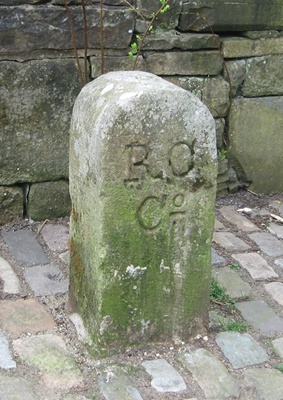
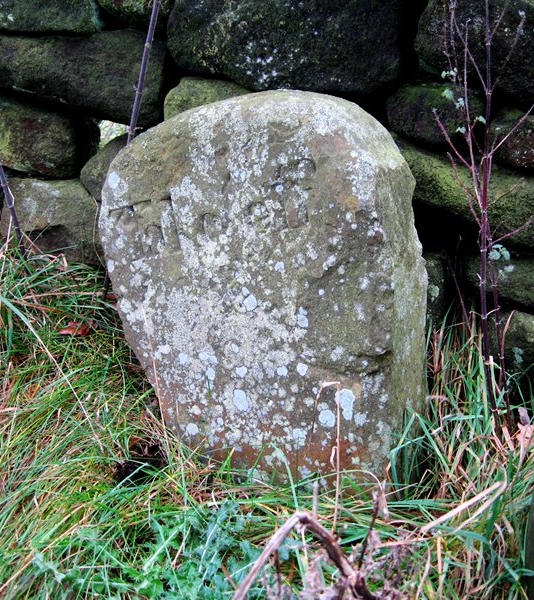
Rochdale Canal: stones marked ‘R C Co’ can be found at Todmorden, Luddenden Foot and Mytholmroyd.  The stne pictured here is at Todmorden

Railways

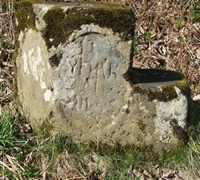
Lancashire and Yorkshire Railway: a stone marked ‘L Y R’ stands beside a Calder & Hebble Navigation milestone at Kirklees Lock, facing onto the canal, with three other markers; other examples can be found at Luddenden Foot and Anchor Pit.

London and North West Railway: around 12 stones on the hillside in the vicinity of Pule Hill, Marsden, marked ‘L N W R’ indicate the boundary around ventilation shafts servicing the three-mile long tunnel under the Pennines. And at Beldon Brook near Lepton a handful of ‘L & N W Ry’ stones mark the company boundary around the foot of an impressive disused viaduct.

Waterworks

The late 19th century was a time of increasing municipal enterprise, including providing a growing population with clean drinking water. These works also needed boundary markers.

Ashton: numbered stones marked ‘ASDWW’ (for Ashton, Stalybridge and Dukinfield Water Works, set up in 1870) can be found around Chew and Dovestones Reservoirs above Greenfield in Saddleworth.  These may be estate boundary markers, but according to www.doveheritage.com they mark the lines of underground water pipes.

Bradford: around 20 stones marked ‘B W B’ can be found around the two Lanshaw Dams on Burley Moor near Ilkley.

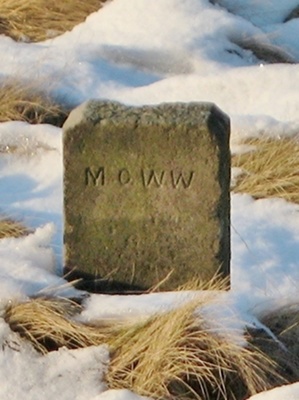
Manchester: some ‘M C W W’ stones on Langsett Moor by Salter’s Brook – the catchment grounds for the reservoirs in Longdendale.  (Pictured right)

Oldham: ‘O C W W’ stones can be found at, among others, Blackstone Edge, Castleshaw, and the delightfully-named Broadhead Noddle in Saddleworth.

Source: an article by David Garside in the Milestone Society Newsletter, no 27, July 2014, pp 26-27.

RWH / Jan 2019

Industrial boundary markers Read More »

Refurbished milestones in the Holme Valley

Milestones around the Holme Valley have been having a clean-up. New Mill resident Rowan Denton was stuck in road works one day and noticed a very decrepit milestone out of his window. Someone ought to do something about that, he thought – and then, the lightbulb moment, why shouldn’t he be that someone?

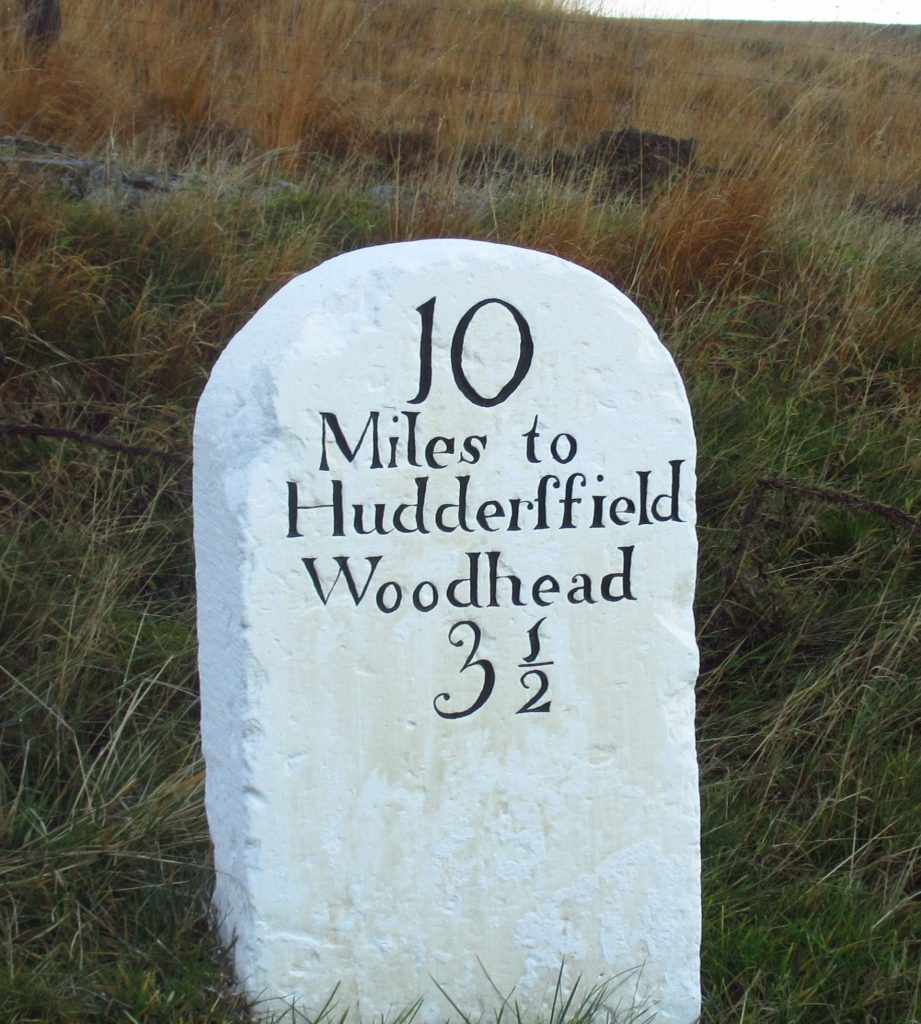
A sculptor, joiner and mould-maker, and former film prop designer, Rowan, now with some funding from the Milestone Society, set about work in the blissfully hot summer of 2018, and his handiwork can be seen on all the roads leading into Holmfirth, and elsewhere. The Brayshaw & Booth stones erected by the West Riding County Council in the mid-1890s, have had their lettering beautifully restored, and Rowan has also painted some of the earlier turnpike stones on the Woodhead Road. These may date from 1768, or 1831 when part of the route of the road was revised – detail above.

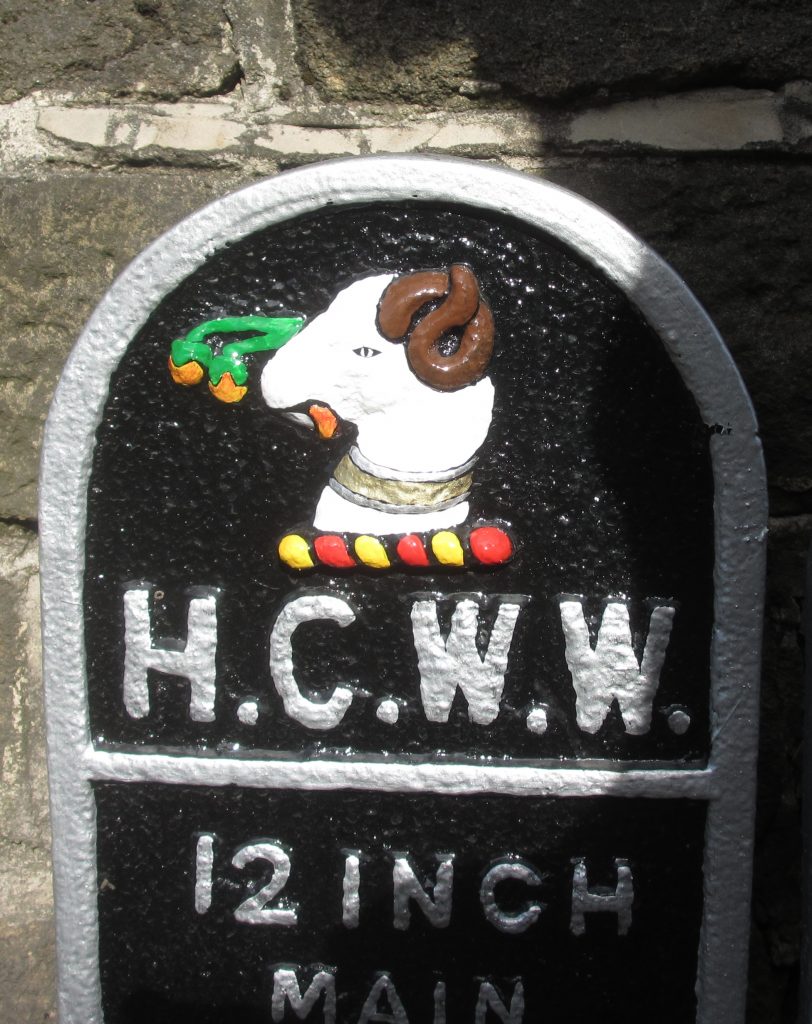
Not content with milestones, Rowan has also restored some boundary stones (in This image has an empty alt attribute; its file name is HV-Rowan-HCWW-det-812x1024.jpgwhich the Holme Valley abounds), road name signs, and some plates from former water undertakings (Batley Corporation, Huddersfield Corporation and New Mill Urban District Council). The lamb that tops Huddersfield’s coat-of-arms looks especially attractive now – pictured right.

Pictured below are before and after photos of YW_GFSLH13 on the A635 at the top of the hill above New Mill.

Sadly (for us) Rowan has now left the district.

See also the Huddersfield Examiner, 19 July 2018, or watch a BBC news report at www.bbc.co.uk/news/av/uk-england-leeds-45334807/a-milestone-in-yorkshire-history-brought-back-to-life

RWH / Jan 2019

Refurbished milestones in the Holme Valley Read More »

B6265: the road to nowhere

Anyone attending the Society’s Northern Spring Meetings from south of Hebden will probably have travelled on the B6265.  It starts outside the church at the top of the High Street in Skipton and heads northwards, through Grassington, to Hebden.  But how many travelling this way have noticed what it does next?  Read on to discover its peculiar 45-mile semi-circular route through some lovely countryside and interesting towns and cities to end up nowhere in particular.

It started life (in its modern incarnation) as the Skipton and Pateley Bridge Turnpike.  On the first milestone out of Skipton, however, a West Riding CC Brayshaw and Booth replacement of the 1890s, the road is described as the Skipton and Cracoe Road.  There are three of these – numbers 4 and 5 have not been found – after which one would not expect any more if the County Council thought the road stopped at Cracoe – though why they did not erect more will remain a mystery.
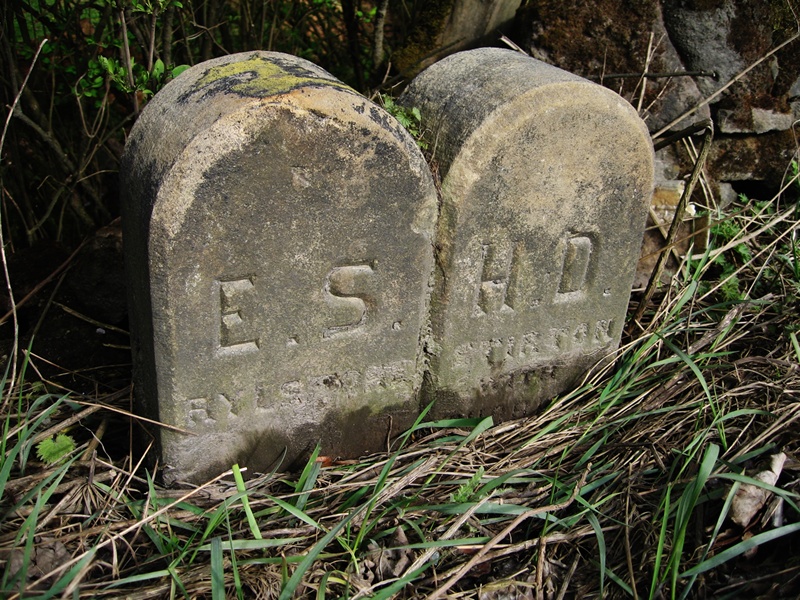
This image has an empty alt attribute; its file name is m_1-ESHD.jpgThere are several boundary stones and guide-stoops on this first stretch. One stone, marking the boundary between Rylstone and Stirton with Thorlby, has the initials ESHD: the East Staincliffe Highway District erected a number of boundary stones in their area. 

The guide-stoops, undated but probably from the early 18th century, are all in a similar style, usually with a pointing finger.
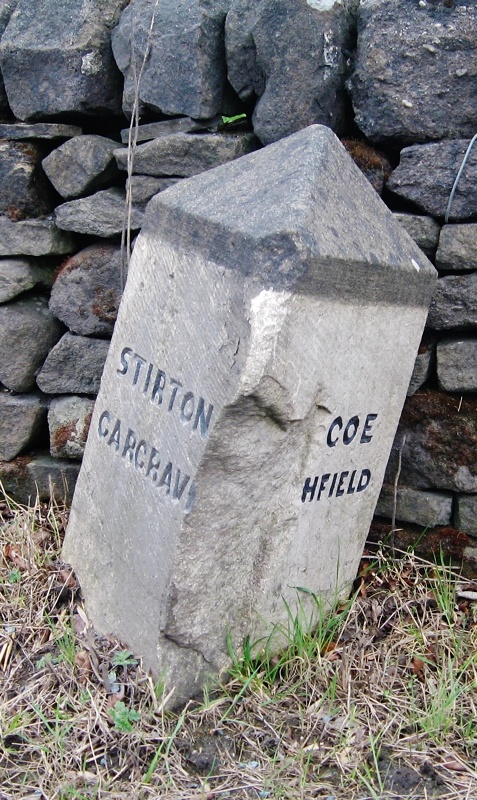
This image has an empty alt attribute; its file name is m_2-Near-None-go-by-on-B6265-to-Cracoe-Threshfield-IMG_0081-2.jpgAbout 2 km beyond Cracoe a branch of the road forks off to the right to Linton, where it loses its B-road designation but continues to rejoin the main line just before the bridge at Grassington – the main section having carried on to Threshfield and around to Grassington.  There are three more guide-stoops in and around Linton.

There are also two earlier milestones, one marking seven miles from Skipton, just beyond the junction with the branch road to Linton, and one marking eight miles on the branch road in Linton itself.  It is presumed that they are the original turnpike milestones, although it is not until the 1894 edition that they are shown on the Ordnance Survey maps, and there is one in an identical style further up the dale beyond Threshfield and not on the actual turnpike.

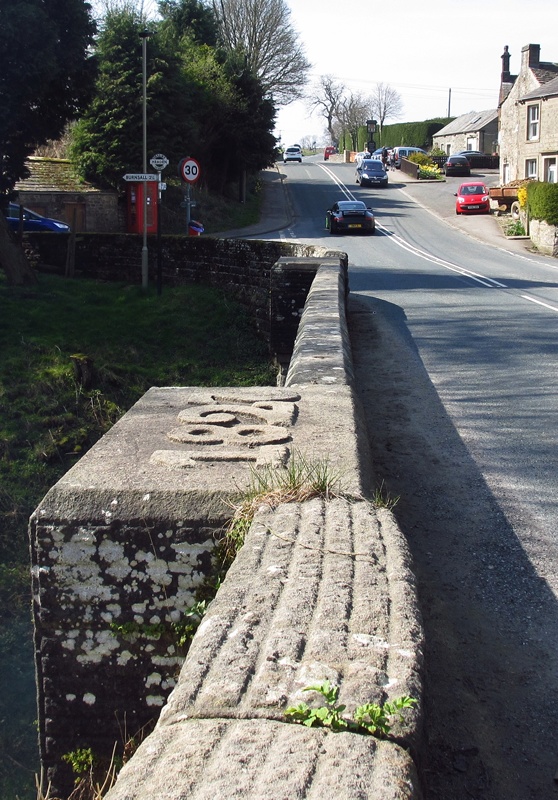
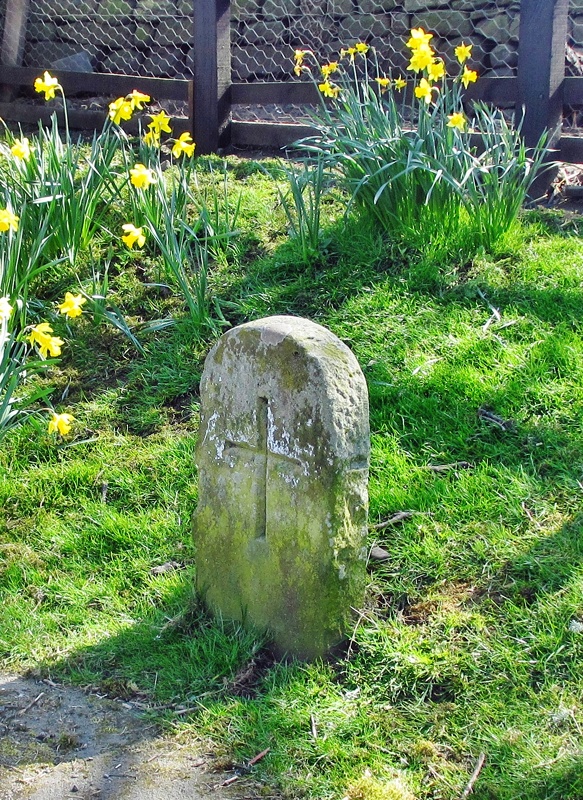
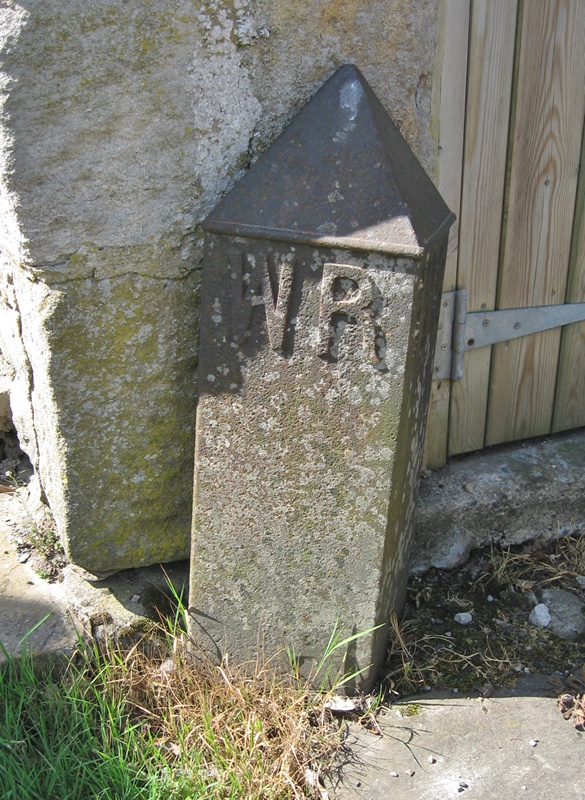
And so to Hebden.  There are two bridges in Hebden, the old mediaeval one with a WR county bridge stone (pictured below, left), and the nineteenth-century one when the road was widened; this has a large 1827 carved on the parapet (pictured below, centre).  Just off the road is a rather weathered guide-stoop, and just as you enter the village an interesting old stone on the right bears a simple cross (pictured below, right).  This is actually a county bridge stone, denoting the point 300 feet from the bridge, where the parish responsibility for the road ended, and the county’s responsibility, for the bridge, began.  There is a similar stone at Skirfare Bridge higher up Wharfedale.
This image has an empty alt attribute; its file name is m_4-WR-Hebden-IMG_4720.jpgThis image has an empty alt attribute; its file name is m_5-1827-Hebden-IMG_4906.jpgThis image has an empty alt attribute; its file name is m_6-X-Hebden-IMG_4907.jpg

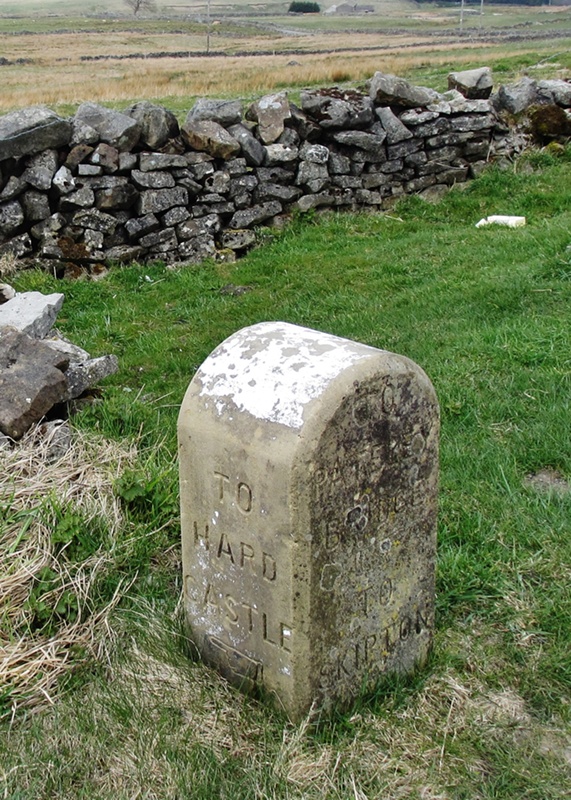
This image has an empty alt attribute; its file name is m_7-B6265-nr-Greenhow-IMG_6020.jpgBeyond Hebden there are more guide-stoops, including, after Stump Cross Caverns, near Greenhow one in a different style with fingers pointing to Hardcastle, a now deserted but once bustling mining area (pictured left).  And it’s also worth a look at Toft Gate Lime Kiln, just beyond.

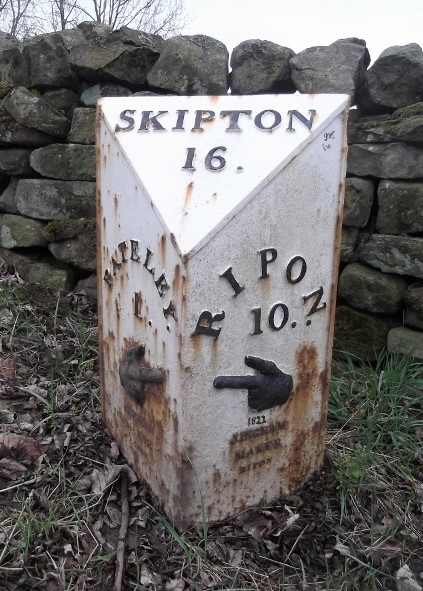
The road now enters Pateley Bridge, where it turns right and for a mile joins the B6165. While that heads for Knaresborough our B6265 turns off and meanders north-east, passing the entrance to Studley Royal and Fountains Abbey, to Ripon. This image has an empty alt attribute; its file name is Pateley-Bridge-Ingram-ms.jpgThis, according to the 1854 Ordnance Survey map, is the province of the Ripon and Pateley Bridge Turnpike Trust.  Along the road is a series of milestones, some in need of some TLC, with iron plates cast by Ingram, ironfounders of Ripon, many more of whose milestones can be found on other roads from Ripon.  The last (or first from our direction) of these is in Pateley Bridge itself, on Ripon Road.  The one illustrated here is the first one encountered on the B6265 as it turns off the B6165.
Finally, beyond Ripon, the road heads east (on part of the Harrogate and Hewick Turnpike) and then back south towards Boroughbridge: now on the line of the former A1, the Great North Road before it was widened, earlier the Boroughbridge and Piercebridge Turnpike, and long before that the Roman Dere Street.

The milestones on the stretch from Ripon are of the Ingram variety, but on the old Great North Road there is a different style with directions to Piercebridge.  After Boroughbridge the Great North Road continues south to Wetherby while Dere Street, now the B6265, heads for York, part of the Boroughbridge and York Turnpike.  A few milestones survive, but after about ten miles the road finally comes to an end at its junction with the A59 near Green Hammerton.

Curiously there is a bit more of the B6265.  With the development of the A650/A629 Aire Valley Trunk Road, two old sections of the road have been re-designated as the B6265: one from Crosshills through Steeton into Keighley; the other from Keighley through Bingley to Cottingley.  Perhaps some misty-eyed planner once thought of joining them all up.

RWH / rev July 2020
B6265: the road to nowhere Read More »

Take-on and take-off stones

A take-on stone is a stone instructing a coachman to add an extra horse or horses to a conveyance in order to help pull the coach up a steep hill.  A take-off stone, conversely, is an instruction to unhitch the horse(s).  Such stones are few.

There are supposed to be three such stones surviving on Mortimer Road, on the moors above Bradfield, near Sheffield.  This road leads from Penistone to Grindleford in the Derbyshire Peak District.  Turnpiked from earlier packhorse routes, it was a financial failure, and its fascinating story is told in a book by Howard Smith (1993).  Its route is also traced on the Stocksbridge and District History Society website.

The take-off stone illustrated here is at the top of the hill just north of the Strines Inn, near the end of the West Riding stretch of the road.

Another such stone can be seen on a bridge near Haworth, with the words “Hang on”.  See the picture from Geograph here.

These stones are also known, at least to the Milestone Society, as “horse stones”, and the horses themselves are also called “cock horses”.  This term has applied to the children’s toy from as long ago as Tudor times, while the Banbury Cross nursery rhyme dates to the 18th century.  Its use in our context, however, is more recent: the OED has its earliest usage as comparatively recently as the late 19th century.  A quotation from The Field  of 25th July 1891 reads “With no further use for the cock horse, we cast him off at the top of the hill”.

RWH / Oct 2015, rev June 2024

Take-on and take-off stones Read More »

Beverley Sanctuary Stones

The concept of sanctuary, as a place where fugitives can be immune from arrest, dates back to the Bible (cf Numbers, 35), and was recognised in English law until abolished by James I in the 17th century.  It was a way to protect people from the vagaries of mob justice.  All churches could offer sanctuary within the actual church building, but there were over 20 churches in mediaeval England (including Beverley, Ripon and York in Yorkshire) which were able to provide a wider area of sanctuary.

In Beverley sanctuary began approximately two miles from the Minster.  If a pursuer caught his quarry within this area he had to pay a fine to the church authorities.  To denote the area sanctuary stones were set up on four of the main approaches to the town – these were tall columns with richly carved crosses – and there were other crosses nearer the Minster at points where fines increased.

Three of the outermost sanctuary crosses survive, though much defaced and without their tops, probably occasioned by post-Reformation zeal.

One is on the A164 road from Hessle and the Humber, just south of its intersection with the A1079.  This would have been the main route from Lincoln and the south.  On a square base, the column is 21/2 feet tall and 18 inches thick.  It can be clearly seen, having been rescued from vegetation during construction of the by-pass.

Moving clockwise the next is at Walkington on the route from Howden and the south-west.  Similar in size to the Hessle cross, this (illustrated) is on the left just past the traffic-lights coming from Beverley.

The third surviving stone is at Killingwoldgraves near Bishop Burton on the road to York (the A1174) just before the by-pass (again coming from Beverley).  Better preserved and taller than the other two, with some decorative features surviving, this is slightly away from the road and on a higher vantage point, perhaps to make it more visible (unless, of course, it has been moved).

The fourth, missing stone was on the road to Driffield and the north, the A164.  It is possible that it was lost during the construction of the now disused railway line to Market Weighton.

One sanctuary stone survives of the eight that originally surrounded St Wilfrid’s Monastery (founded 672 AD) in Ripon: Sharow Cross, now cared for by the National Trust, probably dates from the 13th century.  On Dishforth Road at Sharow, just off the A61 on the other side of the River Ure from Ripon itself, it is at SE 3235 7198.  Ripon Cathedral now stands where the original monastery was established.

Sources: Martyn Kirby: Sanctuary: Beverley – a town of refuge (updated ed, 200?); for Sharow Cross: https://historicengland.org.uk/listing/the-list/list-entry/1149835

RWH / rev August 2020

Beverley Sanctuary Stones Read More »

The Stone Chair


In the village of Shelf, on the A6036 between Halifax and Bradford in West Yorkshire, is an area called Stone Chair.  And on an older line of the road, originally the Wibsey Bankfoot and Lidget Branch Turnpike, just north of the Stone Chair roundabout, sits the stone chair that gave its name to the area.

The present structure, a Grade II listed monument, dates from 1891.  It consists of two large upright stone slabs set at right-angles to each other, and joined at the top by an iron strap.  Between the two is a large triangular stone block which acts as a seat – hence the name.

The original stone chair, however, was erected in 1737.  This date would suggest it was put up following directions from the county Justices to local township surveyors to erect stoops to assist travellers at cross-ways – instructions most recently repeated in 1733.

The highways surveyor for the Shelf township at the time of its erection was William Clayton, a blacksmith who also seems to have been the publican of the Duke of York Inn, across the road from the site of the stone chair.  His yearly accounts survive, which record that “a gide erecting and seting up” cost 4s-6d, and “aile when stone was sett up” was 1s-6d.  Clayton died in 1766 and was buried in nearby Coley Church.

The first edition Ordnance Survey 6″ map (published 1854) shows what it calls a milestone, giving the following destinations and distances: Huddersfield 6, Keighley 8, Halifax 2 and Bradford 4.  These are not statute miles but the longer traditional miles, which are usually found on guide-stoops of the period – unlike the miles shown on actual milestones.

In the 1820s, however, the new line of the turnpike had been constructed, and the stone chair had lost its original purpose – whatever that was: possibly a resting-place for people (or, at least, one person) waiting for stage-coaches or other transport – and by the 1880s it had fallen apart, or even been destroyed.

In 1890 local antiquarian and writer Harry Speight claimed to have unearthed one of the stone slabs of the original chair from beneath a heap of rubbish on its original site; its inscription had been defaced. From Speight’s description and illustration of the original chair (and there is no other source to confirm its original appearance) a new one was erected in 1891, with new stone slabs.  The destinations differ from those on the OS map: Bradford and Halifax remain, but Keighley and Huddersfield have been replaced by the nearer Denholme Gate and Brighouse.  Speight’s defaced 1737 slab is probably the one now built into the wall of the house next to the chair: it can be seen in the lower photograph.

Source: article by Ben Stables in the Milestone Society Newsletter (no 29, July 2015, pp 35-36)

RWH/Oct 2015

The Stone Chair Read More »

Manchester 19, overlooking Woodhead Reservoir

Milestones on an old saltway to South Yorkshire

Manchester 19, overlooking Woodhead Reservoir

Salt had many uses in mediaeval times (and earlier) but was most valuable as a food preservative.  The main source of salt for inland areas of the north was Cheshire – the so-called “Cheshire wiches” of Middlewich, Nantwich and Northwich.  The saltways along which this vital commodity was carried can be traced in many street and area names still found today: Salters Ford, Saltergate, Salter Hill, etc.  Even Psalters Lane in Rotherham is derived from the salt route rather than any monastic connection.

One route entered the West Riding (South Yorkshire) via Stockport and the Longdendale Valley at the appropriately-named Salter’s Brook Bridge, the boundary between Yorkshire and Cheshire (though now Derbyshire), near Woodhead.  This road was turnpiked by the Doncaster and Salter’s Brook Trust in 1740, connecting with the slightly earlier Manchester and Salter’s Brook Turnpike.  In 1828, in the second wave of “turnpike mania” this route was replaced by a new one, easing the gradients, and running sometimes north, sometimes south of the old saltway.  This road is the present A628, but the old route between Woodhead and the now demolished Flouch Inn can be easily traced on an Ordnance Survey map.  A mile or so beyond the Flouch the turnpike continued past Barnsley to Doncaster, while another branch of the old saltway headed right for Rotherham.
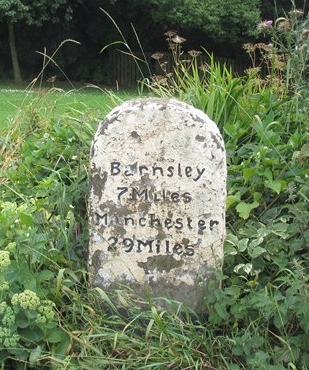
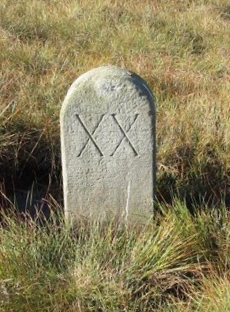
Many old milestones survive on both routes: the new road was never provided with the Brayshaw and Booth stones set up shortly after the County Council took over responsibility for highways in the 1890s. The milestones on the old route are especially interesting.  Starting just over the boundary in Cheshire one can be found built into a wall overlooking Woodhead Reservoir (grid ref SE 1055 0005): this gives the miles to Manchester (19) – top picture.  The next milestone, the last in Cheshire/Derbyshire, is missing.

Many of those on the Yorkshire side, however, survive, and have been traced by David Hey.  These quote the number of miles to Rotherham, which are given in Roman numerals – though the actual destination is not usually named.  The first, very close to the county boundary, is badly eroded, but reads “Wortley XII Miles Rotherham XXI Miles”.  The next, 20 (XX) miles to Rotherham, the second picture (right) is at SE 1550 0005, south of the A628 at Fiddlers Green.

The picture at the bottom shows the later Doncaster turnpike milestone on a disused stretch of the A628 just west of the Flouch (as was).

The Rotherham branch was turnpiked at the same time as the Doncaster road – hence the milestones – but was not financially successful, particularly after the construction of the Halifax to Sheffield Turnpike (the present A629) in 1777 and today remains as a number of apparently unconnected minor roads.

There are a number of other interesting features on the old road, including some Manchester Corporation Waterworks boundary stones, and the mediaeval Lady Cross.  This marks the eastern boundary of the manor of Glossop, but would also have served as a route marker.  The Lady Cross, the Rotherham 21 milestone, and a number of other stones in the region are marked with the letters IWB – some graffiti by Isaac Watt Boulton.  Boulton (1823-1899), an engineer and industrialist from Ashton (and related to the famous Matthew Boulton of Birmingham) was a keen rambler and campaigned for public access to ancient paths in the Peak District.

Sources: David Hey: talk to the Milestone Society AGM, 2007, and his Packmen, carriers and packhorse roads, 2nd ed (Landmark Pub, 2004); Stocksbridge and District History Society website, and an article by W E Spencer in their newsletter, Paragon, no 12, summer 1998, also available online; Fell Runners Association forum; Grace’s Guide to British Industrial History.

RWH/rev June 2020

Milestones on an old saltway to South Yorkshire Read More »